Fuel Injector Tester Guide: First Signs of a Bad Injector and How to Test Them
The first signs of a bad injector are rough idle, hesitation, misfires and rising fuel use. Plugs, coils, vacuum leaks and weak batteries cause the same complaints, so symptoms alone prove nothing. Diagnosis climbs a ladder: on-car checks, then resistance, then bench flow, balance and spray testing with the injector off the engine.
By the Winsen (WSAT) workshop equipment team, Jiaxing, China. General workshop practice only; OEM service data always takes priority.
What Are the First Signs of a Bad Injector?
Symptoms start subtle and overlap. Treat each as a prompt for one specific first check.
Symptom
What the injector may be doing
First check
Rough idle
Uneven delivery between cylinders
Per-cylinder misfire counters
Hesitation under load
Restricted flow starving a cylinder
Fuel trims and pressure under load
Misfire code or flashing check-engine light
Stuck open, stuck closed or open coil
Swap the coil and see if the fault follows
Hard or long cranking
Leaking injector bleeding off rail pressure
Pressure leak-down after shutoff
Worse fuel economy
Dripping or over-delivering
Long-term fuel trim
Fuel smell, rich or black smoke
Leaking seat or stuck-open nozzle
Leak-down, then inspect plugs
Lean codes
Clogged screen or nozzle tip
Fuel pressure, after excluding vacuum leaks
No injector click
Electrical or driver fault
Stethoscope or noid light, then resistance
Rule out the cheap causes first
Low system voltage causes slow cranking, erratic injector response and false misfire patterns, so check the vehicle with a battery tester for car and EV batteries before pulling anything. Then check plugs, coils, vacuum leaks and fuel pressure. A misfire that follows the coil when swapped is not an injector fault.
Which Test Confirms What? The Injector Test Ladder
Work from the cheapest check to the most thorough, and stop when the cause is found.
On-car checks
Click test: a stethoscope on the injector body shows whether the solenoid fires. A click proves the coil works, not that fuel flows.
Scan data: fuel trims and misfire counters narrow the suspects before any injector comes off.
Fuel pressure and leak-down: a drop after shutoff can implicate a leaking injector, the pump check valve or the regulator, without saying which.
Resistance and pulse width with a multimeter
With the connector unplugged, measure ohms across the injector terminals. As typical ranges, high-impedance injectors read about 12–16 Ω and low-impedance (peak-and-hold) injectors about 2–5 Ω. These are guides only: the OEM spec for that engine governs, and readings shift with temperature. Live pulse width shows what the ECU is commanding.
A multimeter has a hard limit. A coil can read perfectly while the pintle is gummed up or the nozzle atomizes badly. It confirms the electrical side and says nothing about flow or spray.
Why bench testing is the next step
Flow, spray quality and seat leakage can only be judged with the injector off the engine, fed test fluid at controlled pressure and fired with controlled pulses. A bench tester beats a multimeter for all three. Additives and straight replacement are cheaper alternatives to a bench injector tester, but neither measures flow, spray or leakage.
What a Bench Fuel Injector Tester Actually Checks
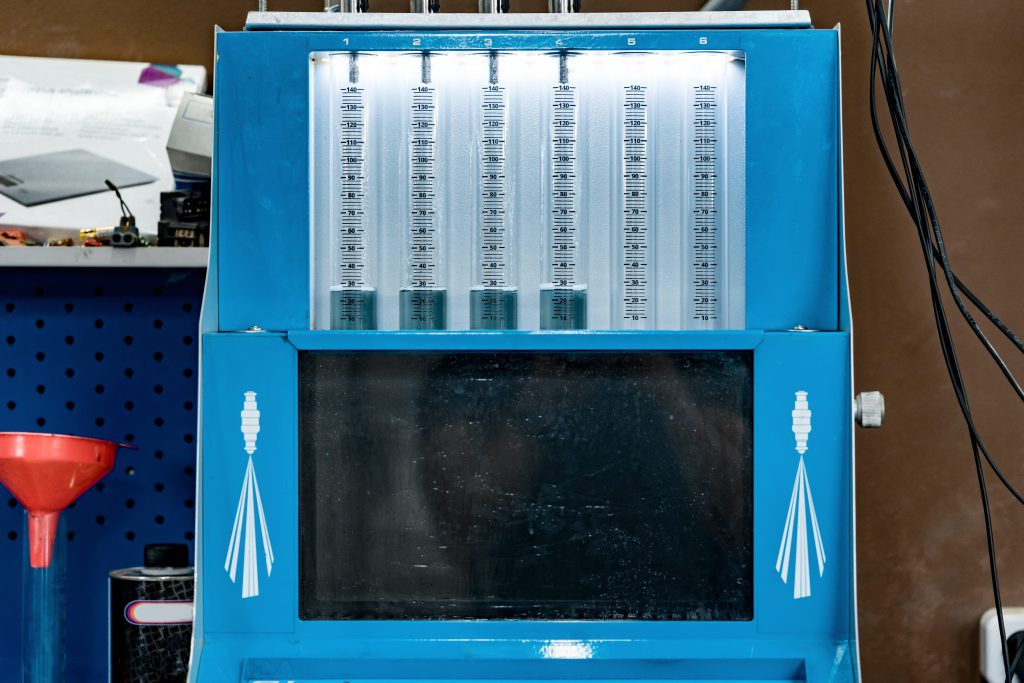
A bench unit combines a pump and rail, a pulse controller, graduated cylinders and, on many models, an ultrasonic cleaning tank. It simulates engine conditions without an engine.
Flow and balance
Each injector fires into its own graduated tube on identical pulse settings, and delivered volumes are compared across the set. Run idle-type, mid-range and high-load pulses, because an injector can look fine at one setting and drift at another.
Spray pattern and leak-down
A healthy injector produces a fine, even cone or jets. Solid streams, an off-axis cone or uneven atomization point to deposits or a worn tip. Held under pressure without pulsing, any drip or post-pulse dribble means seat leakage, which usually means replacement.
Ultrasonic cleaning, then re-test
Ultrasonic cleaning uses high-frequency vibration in a cleaning bath to loosen varnish and carbon from the nozzle and internal passages. The re-test is the verdict. If flow and spray match the rest of the set, the injector goes back with fresh O-rings and filter baskets. If not, replace it.
A worked example
These numbers are illustrative, not machine data. A four-cylinder set is fired at one pulse setting and delivers 58, 59, 60 and 49 ml. The set average is 56.5 ml, so cylinder four sits about 13% low, with a streaky spray. After one ultrasonic cycle it delivers 58 ml with an even cone, within about 1–2% of the average, so it is reinstalled. Had it stayed near 50 ml, it would be replaced.
How Do I Use a Fuel Injector Tester?
The machine manual sets the exact sequence. The general workflow:
Fill the test-fluid reservoir to the marked level.
Mount each injector on the rail with the correct adapters and seals.
Connect the pulse harness.
Run leak-down, then flow and spray tests at several pulse settings.
Record each cylinder.
Clean ultrasonically if needed, then repeat.
Cleaning fluid is not test fluid, and the manufacturer specifies which fluid to use. Supported injector types, such as port versus direct injection, vary by machine.
What Should My Injector Balance Rate Be?
Balance rate is the variance in delivered volume across a set under identical pulses. A common shop guideline is each injector within about 2–5% of the set average, tighter for direct injection or performance builds. Treat that as a rule of thumb: the OEM or tester manufacturer’s threshold governs. One outlier means clean and re-test; an outlier that stays out after cleaning means replace.
What to Look for in a Good Fuel Injector Tester
For workshops and distributors, a good tester matches the vehicles being serviced:
Injector types supported: port only, or direct injection too.
Cylinders per run: more positions test whole sets in one pass.
Test modes: adjustable pulse and several load simulations, not one preset.
Adapters included: fittings for your regional vehicle mix.
Ultrasonic cleaning: built in, with re-testing in the same session.
Result recording: useful for showing customers before and after.
Diesel: support varies. Some units clean diesel injectors but cannot test them.
Our fuel injector testing and cleaning machine range covers 4-, 6- and 8-cylinder benchtop cleaner-testers for port, GDI and piezo injectors, plus dedicated diesel common-rail test benches. To match a model to your service mix, send us your vehicle mix and volume and we will quote. Workshops and distributors building an injector service line can also download the catalogue for the full equipment range.
Frequently Asked Questions About Auto Repair Shop Equipment
What’s the best way to test a fuel injector?
Climb the ladder in order: click and scan data, fuel pressure, resistance against OEM spec, then bench flow, spray and leak-down. Stopping at the multimeter misses clogged injectors whose coils read normally.
How do I use a fuel injector tester?
Mount the injector with matching adapters and seals, connect the harness, and run leak-down, flow and spray at several pulse settings. Record every cylinder, clean if needed, then re-test.
What should my injector balance rate be?
There is no universal figure. About 2–5% of the set average is a common guideline, but the OEM or machine-maker threshold overrides it, especially on direct injection.
What is a good tester for fuel injectors?
One that supports the injector types you actually service, tests a full set per run, offers adjustable pulses and adapters for your vehicle mix, and re-tests after cleaning in one session.
Can I test diesel injectors with the same tester?
Usually not. Diesel injectors run at far higher pressures, so a gasoline bench may clean them but not test them. Confirm the supported injector list before ordering.
Can ultrasonic cleaning fix a bad injector?
It removes varnish and carbon, not a worn seat, damaged nozzle or failed coil. Only the post-clean re-test shows whether flow and spray recovered, and no result is guaranteed.
Yes. We provide OEM and ODM services, including logo printing, custom colors, packaging design, and product specification adjustments. Available options depend on the product type and order quantity.
What is your minimum order quantity (MOQ)?
MOQ requirements vary by product. Most standard products are available in flexible quantities, while customized branding, packaging, or product development may require a minimum order. Contact us with the product model and required quantity for confirmation.
Do you offer samples?
Samples or trial orders are available for most product categories. Sample charges and refund terms depend on the selected product and will be confirmed before ordering.
Which ports do you ship from?
We can arrange shipment from major ports in China, including Shanghai, Ningbo, Shenzhen, and Qingdao. The final port will be selected according to the product location and shipping arrangement.
Which trade terms do you support?
We support EXW, FOB, CIF, and other standard international trade terms. The available option will be confirmed in your quotation based on the order and destination.
Can you supply products beyond your catalog?
Yes. If you cannot find the required automotive tool or workshop equipment in our catalog, send us your specifications, target quantity, and application. Our team can help identify and source a suitable solution.